Different Types of Holograms – Holocenter
Source: https://holocenter.org/what-is-holography/different-types-of-holograms
As described in the History of Holograms transmission and reflection holograms have different fringe structures so look different.
In the reflection hologram only selected wavelengths (colors) are reconstructed while the transmission hologram diffracts all the wavelengths of light so can it can have a rainbow appearance. The hologram does not change the wavelength (color) of light but controls how light is re-directed.
There are a number of distinct types of art holograms that can be defined by their optical-geometry and the recording medium.
The Denisyuk Reflection Hologram
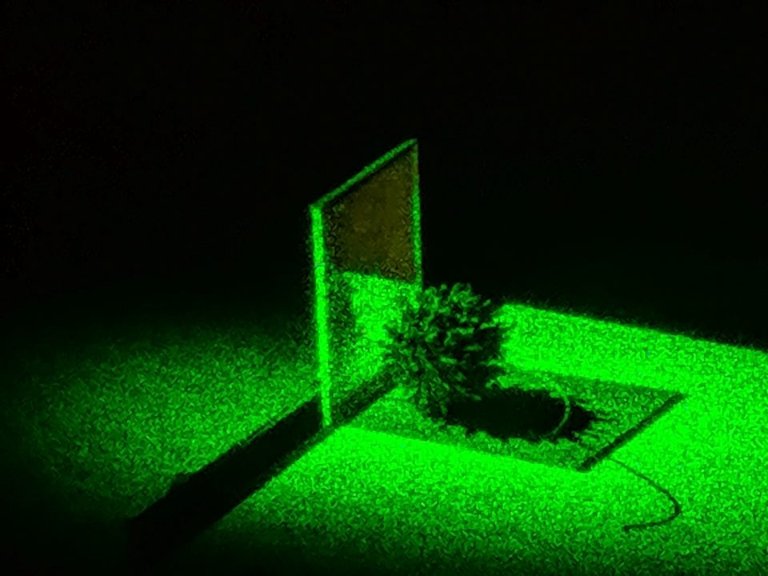
A Denisyuk hologram is created with a ‘single’ beam’ of laser light that is shone through the hologram surface and then bounces off object back into the hologram surface.
Unless the physical structure is chemically manipulated the reflection hologram will appear the color that it is recorded. To create a true color refection hologram a multiple laser colors are combined – usually a red, green and blue.
Hans Bjelkhagen uses three or more laser colors to create true color Denisyuk holograms
Pseudo-color Reflection Hologram
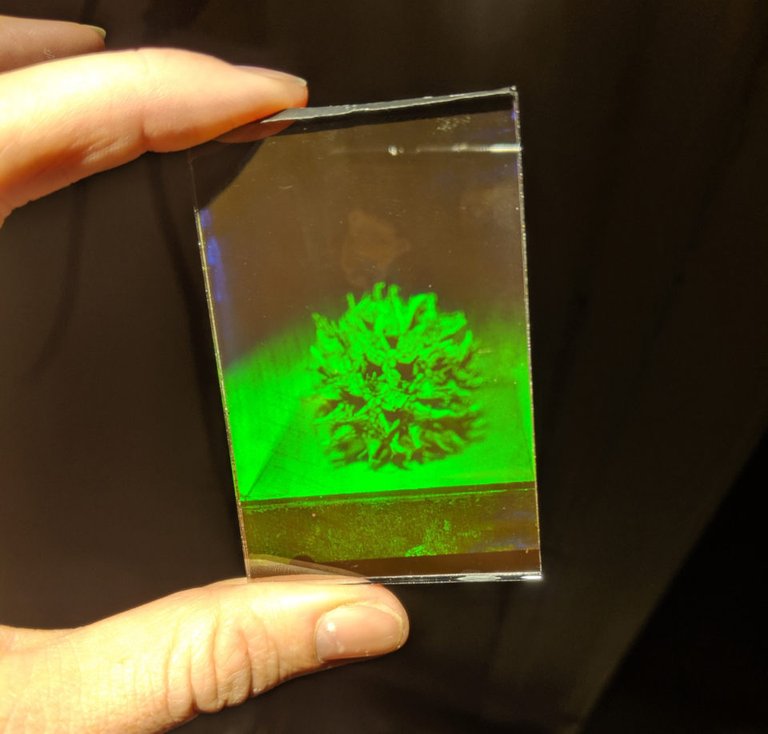
Hologram are images of light, so colors are controlled by selecting and combining spectral colors.
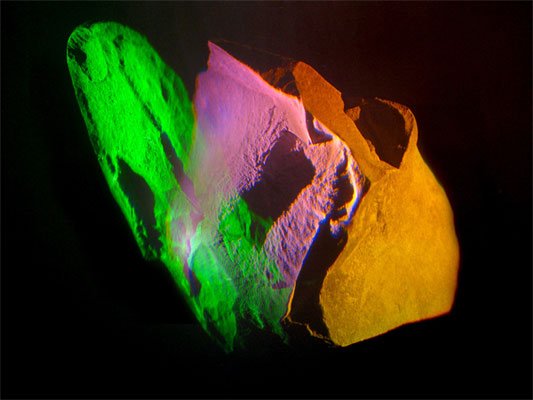
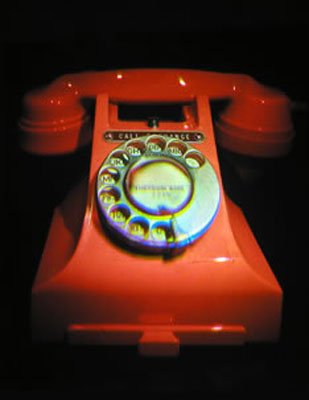
is By manipulating the chemical processing of , the holographic fringe structure can be expanded or shrunk changing the color of the reconstructed image. Pseudo-color reflection holograms can be created through multiple exposures between which the emulsion is swollen or shrunk to shift the recorded fringe spacing and therefore color, a technique that has been used extensively by John Kaufman and Iñaki Beguiristain.
John Kaufman, Canted Fragment, 1994Pseudo-colour Reflection Hologram, 30 x 40 cm(image courtesy of the artist)
Iñaki Beguiristain, Telephone – Theydon Bois 2286, 2001Pseudo-colour reflection hologram, 30 x 40 cm(via: Inaki Beguiristain)
Laser viewable transmission holograms
The laser viewable transmission hologram allows for a near perfect reconstruction of the optical field. This means that the recorded scene appears behind the film, and when replayed by a laser this scene can be very deep and sharp. These holograms are also used as a master recording that can then be transferred into a reflection or transmission holographic print.
Artist Paula Dawson who has worked extensively with laser viewable
transmission holograms describes these recordings as ‘concrete’
holographic images because they create a sense of physical presence.
Left: Paula Dawson To Absent Friends, 1989 | One of the laser transmission holograms, 150 x 95 cm Right: Two perspectives showing the details of the scene from small holograms 4 x 5” (10.2 x 12.7 cm) The Jonathan Ross Hologram Collection
Rainbow Holograms
Transmission holograms have a different a visual quality and the color is controlled by geometry rather than chemistry. When illuminated with a white (broad spectrum) light source the transmission hologram will diffract all the wavelengths of light into the image. However as red-wavelengths are longer, they are deflected more than blue-wavelengths and so the image will have some color smear – the light spreads into a rainbow image.
OCEAN SKY by Sam Moree (2018) Sculpture with two rainbow hologram panels on plexiglass 20 x 18″ a Holographic Art Grant Commission printed by John Perry at Holographics North.
A rainbow hologram, recorded from a horizontal master strip and replayed with a light from above, will have horizontal parallax – enabling the spatial qualities when looking with two eyes or moving side-to-side. But moving up-and-down produces no change in spatial perspective and viewer only sees a change of color. By recording a number of masters on an achromatic angle the spectral colors can be recombine to produce images that are whitish (achromatic) or color-mixed (ie, RGB red+green+blue).

Martina Mrongovius, Pascua Lama, 2006, 30 x 40 cmLeft: Three master strips recorded onto a single piece of filmRight: Three-colour (red, green and blue) multiplex holographic print
Margaret Benyon and Dieter Jung, ‘Colour Test’ early 90s
Pulse laser holography
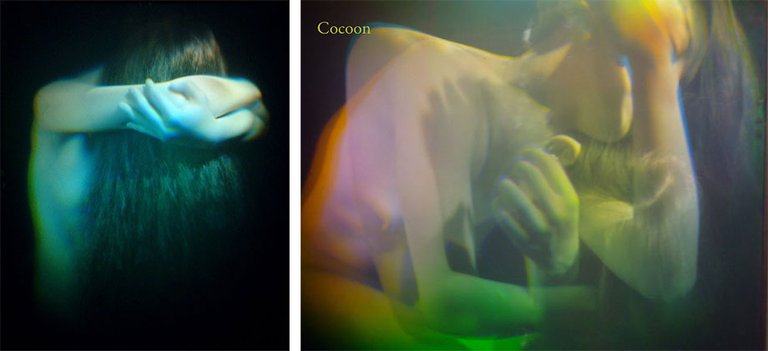
Recording a hologram requires the interference pattern to be stationary during the exposure. For this reason holograms are traditionally made of static sculptures on vibration isolated tables. A pulse laser produces an ultra short flash of light, thus freezing motion and allowing for holograms of live subjects.
Pulse Laser Holograms by Ana Maria NicholsonLeft: At the Gate, 60 x 50 cm. Right: Cocoon, 50 x 60 cmTwo-color (color mix) reflection holograms from pulse laser masters(images courtesy of the artist)
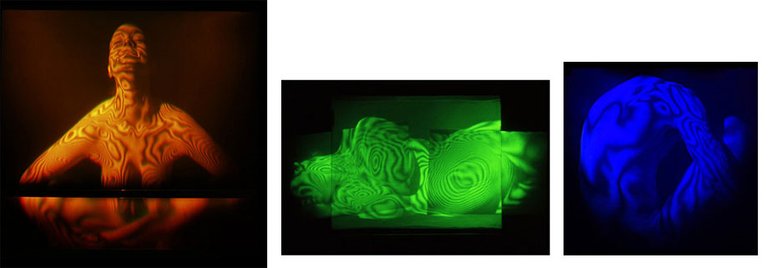
Holographic interferometry
As the holographic recording process is dependent on the interference pattern between optical-waves the holographic image is the comparative shape between these waves. Holographic interferometry utilizes this property to detected small variations in form, with applications in industrial non-destructive testing. As part of her ‘Strata Series’ Sally Weber used a holographic interferometry technique – a double laser pulse – to show the movements of breath and blood under the skin.
Sally Weber, ‘Descent’ a six part series of holograms for the ‘Strata Series’, 2006Open-aperture (laser-viewable), transmission hologramsLeft to right: Laccolith, 26 x 27” (66 x 69 cm). Terrain, 18 x 36” (46 x 91 cm). Fossil, 26 x 26” (66 x 66 cm)The pulse masters were recorded in 2001 at the Center for the Holographic Arts(via: http://www.sallyweber.com/descent.htm)
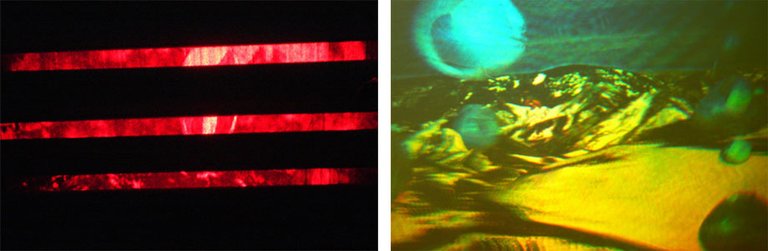
Holographic Optical Elements
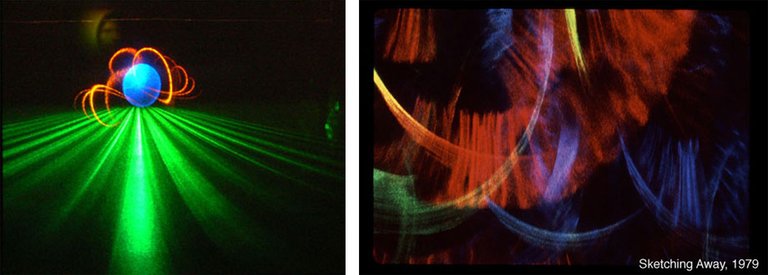
Holograms can also be used to direct light, which has commercial application in lighting design as well as being used for video projection screens and AR displays6. This property has been incorporated into the process of making holograms by artists. Before the stenciling and digital printing techniques became widely practiced, Rudie Berkhout was creating spatially dynamic holograms using multiple holographic optical elements (HOEs) to shape light into dynamic abstract images. Berkhout’s work explores the optical landscape in relation to a cosmic nature of the perceptual field: “I like the work to oscillate between landscape and abstract painting, challenging viewers and jolting their usual perception of the world.”7
Holograms by Rudie BerkhoutLeft: Event Horizon, 1980. 8×10” White-light transmission hologram laminated in 30 x 40 cmRight: Sketching Away 1979. 8×10” White-light transmission hologram laminated in 30 x 40 cm(courtesy of the Rudie Berkhout holography collection)
Stenciling and Multiplex holography
Multiplexing is a technique of recording multiple holographic
exposures across the surface of the master hologram. By transferring a
multiplexed master, a final print can be produced where the ‘virtual
windows’ onto the scene is fragmented allowing for spatial animation,
stereopsis and depth perception by parallax as the viewer moves around.
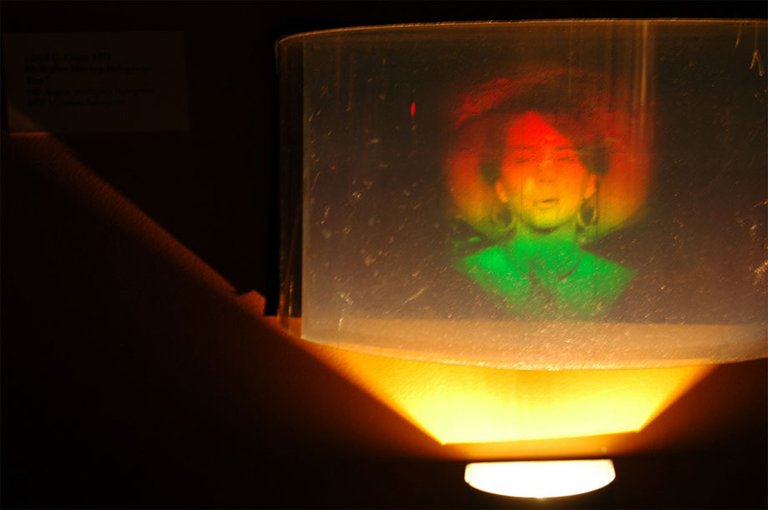
Lloyd Cross developed a one step process of recording multiplex holograms in 1972, using a sequence of film frames to make a cylindrical hologram where the image appears in the center. The process combines cinematographic and holographic techniques to display a short animated image loop. By either rotating the cylinder or if the viewer walks around they see the image animated.
Lloyd Cross and Pam Brazier, The Kiss, 1973Multiplex hologram, on exhibition at MIT Museum(image courtesy nsicchia)
Lloyd Cross and Pam Brazier, The Kiss II, 1976Multiplex hologram on film 12 x 23 cm(via Jonathan Ross Hologram Collection)
Taking a photographic approach to multiplexing Patrick Boyd made a
number of multiplex holograms in the early 90s using a process of hand
animation with image slides and stencils over the hologram. He describes
the duration enfolded within his multiplex holograms – “The work is
essentially an interactive experience for the viewer, but during which
he remains in control, deciding for himself the speed with which the
image is revealed and explored, frame by frame.”8
Patrick Boyd, Bartus Takes a Downtown Train, 1990Reflection multiplex hologram, 8.5 x 9” (21.6 x 22.9 cm)Three photographs of the hologram at MIT Museum, 2008
By dividing the holographic window into small exposure regions,
multiple 2-d images can be used to synthesize a 3D scene or record an
animation.
David Pizzanelli, Arabesque, 1989.From photographs by Eadweard MuybridgeMirror-backed achromate white-light transmission, multiplex hologram 10 x 8″ (25.4 x 20.3 cm)“The stereo should be viewed with the images no larger than a post-it note (62 mm between similar image points) as the hyper-parallax, caused by the fusion of temporal and stereoscopic parallax (the extended right foot) is really hard to fuse in this pair”, from email instructions from David Pizzanelli that accompanied the image, 2010.
The multiplexing process can also be consider as a means of optically
stencilling different images into a scene. Brigitte Burgmer’s hologram ‘Future Perfect’
was created by masking the master recording in some places leaving only
a tiny window so that artifacts can only be seen from a very particular
position. A negative of the mask was then applied to a flipped master,
filling in the voids with a pseudoscopic9 view of the scene. Burgmer describes this diptych as “visually very complex and a challenge for perception”.10
Photographs of Brigitte Burgmer’s Future Perfect I and II, 1988Reflection holograms 32 x 43 cm(image courtesy of Sammlung Lauk (Lauk Collection)
Dot-matrix holograms
Dot-matrix hologram printing is a technique of building up an image
of diffractive ‘pixels’. Each area is recorded with a particular
geometry that diffracts light by a corresponding angle. The illuminating
light is deflected into varying divergent colour-spectrums. The image
is a tiling of colours which means the images are very bright but do not
have 3-d depth information. Dot-matrix holograms have been used as a
means of decorative ‘light architecture’. Michael Bleyenberg defines
‘light architecture’: “This term indicates a vision: to ‘plan and
construct’ environments beyond everyday perception and experience,
barely tangible, not using solid material, but the ephemeral medium
light.”11
Dot Matrix holograms by Michael BleyenbergEyeFire/AugenFeuer, 2000. German Research Association(DFG) building in Bonn, 13 x 5 m;Close of EyeFire/AugenFeuer;
Computer generated ‘digital’ holography
With computer generated ‘digital’ holograms the fringe pattern of each pixel is calculated and recorded into the hologram. There are a number of ways of making digital holograms in which small regions of the film, termed ‘Voxels’ or ‘Hogels’, are exposed to the pre-calculated fringe pattern, such as by using a spatial light modulator (SLM) or electron beam lithography. In early systems these Hogels were noticeable causing the surface of the hologram to look pixelated.
Digital Hologram by Lana Blum, ‘Birth’ (2016) a Holographic Art Grant Commission printed by Zebra Imaging.
More...
🔐 Cryptographic Verification
Archived URL: https://holocenter.org/what-is-holography/different-types-of-holograms
📄 CONTENT HASHES:
  SHA-256:  72dd9ba7a888b77dcf2be6fe0bedb653f90774184404757208a5fe585474dbc5
  BLAKE2b:  1c88907f2ef0cce55dd34df8cf61e79855c4f970d5c743d56745efafadd2d274
  MD5:      4ca9ada7964edef2ba52bb9a58248be1

📝 TITLE HASHES:
  SHA-256:  e7b8998b8e7dc4cfa16edf79137182158dc06f05e2584e8b74cbe2373878a9c4
  BLAKE2b:  b81ba4825eb648cacf78c918b95144cf9ac40d24c7bd6bc7f0cf15881f8d5426
  MD5:      3c2e5d84e7b92e62de431a606cb660d8

🔒 INTEGRITY HASHES:
  SHA-256:  64239d8969077b14c46595ebda4f69d5b9ea508afe72c7caeb46fefc261b100e
  BLAKE2b:  5bfac3b3286f2b1ecf294ba74b50e46ceb55033e1ad9d17826d0ee764a147472
  MD5:      3c1200077f57ca77cf68d4fa350e550d
Archived with ArcHive - Client-side cryptographic archival system